Lesson 1.1
Why anatomy matters for a personal trainer
Welcome to Combat Longevity Academy and module one of CLA Foundation in Personal Training. I am an AI voice. Everything I say is based on the course book and the sources listed in the course material. This module is about how the body is built and how it works when it trains. That may sound theoretical, but you will use it every day as a trainer: when you choose exercises, when you explain to a client why she should do something, and when you notice that something is not right.
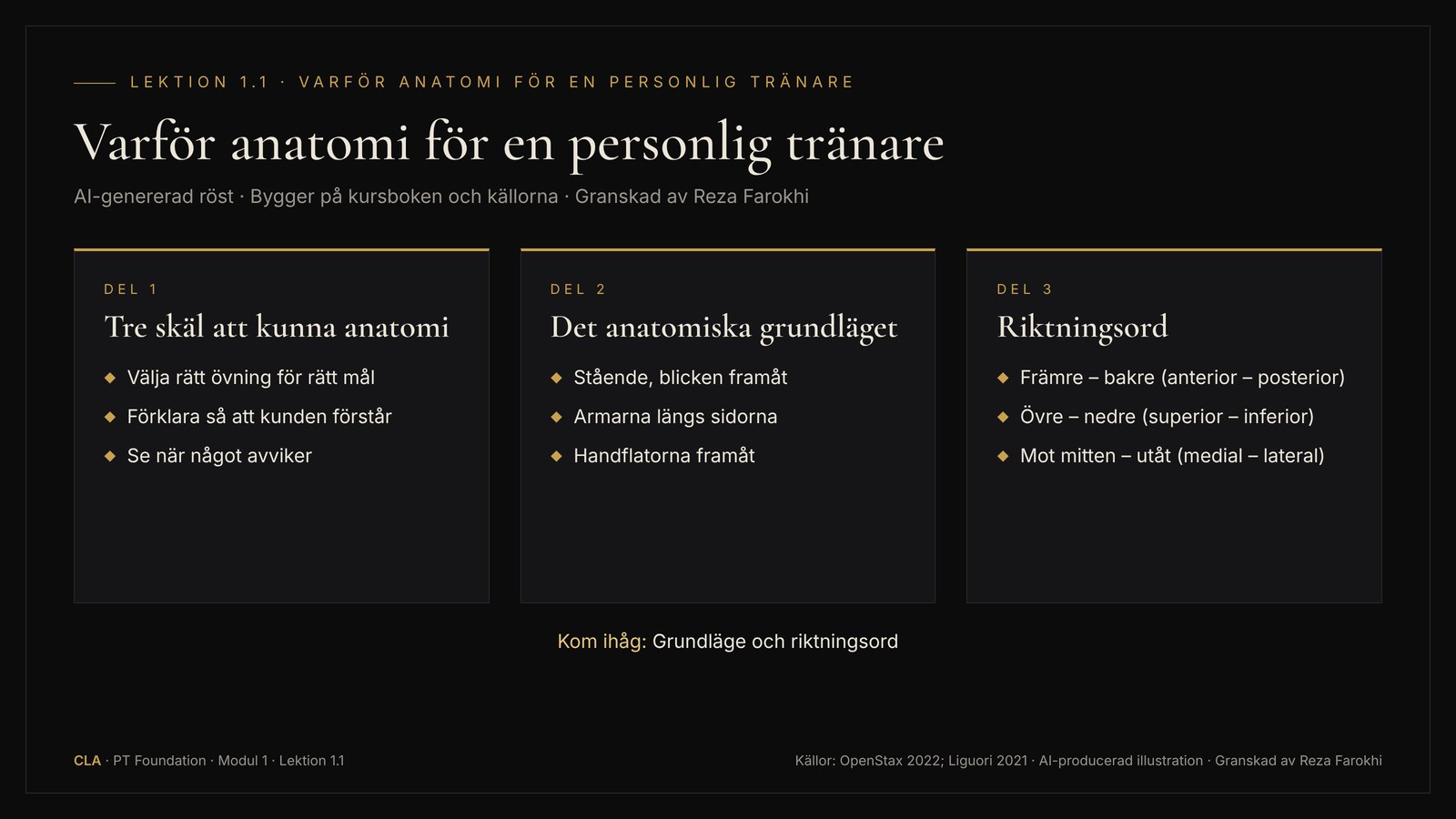
There are three reasons. The first is to choose well. If the client wants stronger hamstrings, you need to know which exercises actually load the hamstrings. The second is to explain. A client who understands why she does an exercise does it more often and better. The third is to notice deviations. When you know what a movement normally looks like, you also see when it does not, for example when a knee drops inward in a squat or when the back rounds in a deadlift.
So that everyone means the same thing, anatomy starts from a fixed reference position. The person stands upright, looking forward, feet close together, arms by the sides and palms facing forward. All directions and movements are described from this position, no matter how the client is actually standing or lying. That way a description means the same thing to you, to the client and to a physiotherapist.
The reference position comes with a few directional terms. Anterior means the front and posterior the back. Superior means above and inferior below. Medial means closer to the midline of the body and lateral further out from it. Proximal and distal are used for the arms and legs: proximal is closer to the trunk and distal further away. So the knee is distal to the hip but proximal to the foot. You do not need to use the Latin words with clients, but you need to understand them when you read and when you talk to healthcare.
An example. After a lunge, a client says: I feel it here at the front. You can translate that to the front of the thigh, just above the knee. A physiotherapist would write anterior, distal thigh. All three mean the same place. Your job is to move between the client's language and the professional language, without making a diagnosis yourself. You describe what you see and what the client says, and if something hurts or does not settle, you refer on.
Knowing anatomy does not give you the right to diagnose. As a personal trainer you describe, adapt the training and refer on. Healthcare examines, diagnoses and treats. A good rule of thumb: if a client has pain that does not settle, pain that radiates, numbness, or a known illness or injury, training should be planned after clearance from healthcare. Referring is not a failure. It is part of the job, and it protects both the client and you.
Three mistakes are common among new trainers. The first is guessing what a pain is caused by and telling the client. Don't, that is healthcare's job. The second is using jargon to sound knowledgeable. Clients usually become less sure, not more confident. The third is memorising names of muscles and bones without understanding what they do. In this module we therefore focus on function: what a structure does, and what that means for training.
The module has ten lessons. First the building blocks: the skeleton, the joints and the spine. Then the muscles, how we describe movement with planes and axes, and biomechanics, meaning levers and forces. Finally the physiology: the energy systems that power the work, the heart and circulation, and the nervous system that controls everything and lets us learn movements. After the lessons there is a case study, a movement analysis task that is checked automatically, practice questions and a module test.
A few tips on how to learn best. Pause the video when a new term comes up and try to explain it in your own words, out loud or on paper. Read the section in the course material after each lesson. And do the practice questions before the module test. Research on learning shows that trying to recall something works better than just rereading it. You can do the practice questions as many times as you like.
Here is how you use this in practice at the very first meeting. The client completes a health form before you train. You ask about previous injuries, operations and problems, and whether anything hurts today. What the client tells you, you note using the directional terms you now know, for example pain on the outside of the right knee when climbing stairs. That way you can follow progress over time, and if the client needs to be referred, you have a clear description to pass on. The notes are personal data and must be stored securely.
Summary. Anatomy gives you a shared language with the client and with healthcare. Everything is described from the anatomical position, using directional terms such as anterior and posterior, medial and lateral, proximal and distal. And your role is to describe, adapt and refer, not to diagnose. A check question to think about: is the elbow proximal or distal to the wrist? The answer is proximal, because it is closer to the trunk. In the next lesson we go through the skeleton.
A shared language for the body
- Describe an exercise precisely
- Understand which muscles it trains
- Talk to physiotherapists and doctors
The foundation for the rest of the course
- Training theory and programme design – module 2
- Strength and conditioning – module 3
- Injury prevention and safety – module 7
After this module you can
- Describe the skeleton, the joints and the spine
- Explain how muscles work
- Use planes, axes and movement terms
- Explain the energy systems, the heart and the nervous system